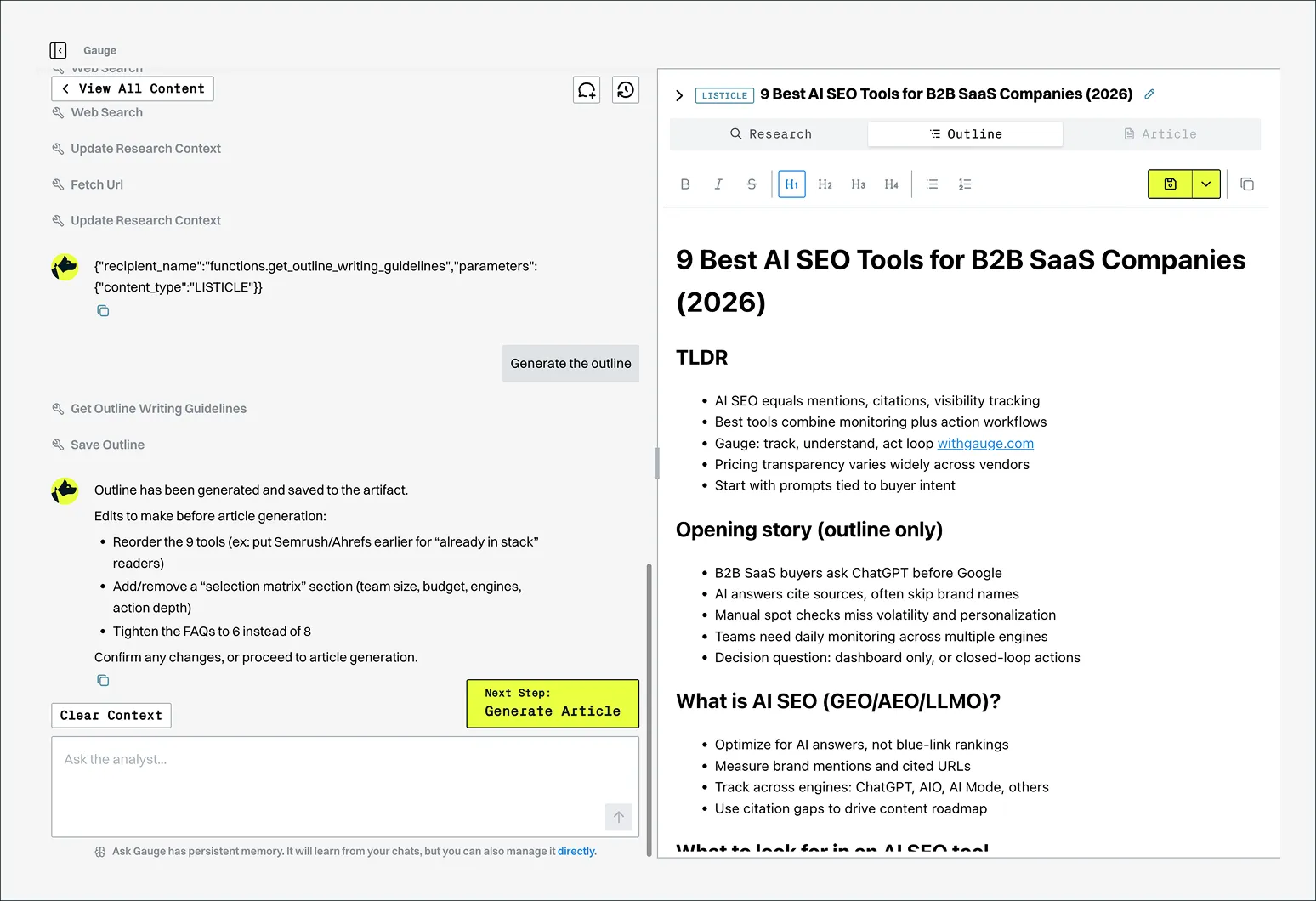
Turn AI Gaps Into Content That Gets Featured

Knowing where you're invisible is just the start. Gauge's Content Engine generates data-driven articles designed to get your brand cited by AI  automatically

Content Built From Real Data

Every article Gauge creates is grounded in what AI platforms are actually citing in your space, not guesswork, not templates.

End-to-End Workflow

From identifying gaps to drafting content to tracking whether it gets picked up, Gauge's content engine owns the full loop so your team doesn't have to.

Targeted by Topic & Prompt

We know which questions are driving AI answers in your category. Your content gets written to answer exactly those questions.

Built for AI, Not Just SEO

AI platforms evaluate content differently than search engines. Gauge's content engine writes for the structure, authority signals, and formats that get cited in generated responses.

How It Works

01

Gauge finds your gaps

We identify the topics where competitors get featured and your brand doesn't
02

We draft the content

Data-driven articles written to match what AI platforms reward
03

You review and publish

Simple approval flow so your team stays in control
04

We track the impact

Watch your citation rate climb as new content gets picked up by AI

Stop Prompting and Start Measuring

Get the complete toolkit you need to fully own, understand, and improve your brand's presence in AI.

FAQs

Find answers to common questions about our app and services.
  • What is Gauge's Content Engine?

    The Content Engine is Gauge's end-to-end content workflow that takes you from identifying AI visibility gaps to publishing articles designed to get your brand cited. It connects directly to your prompt tracking data, so every piece of content is grounded in what AI platforms are actually rewarding in your category, not guesswork.

  • How is this different from a regular AI writing tool?

     Generic AI writers produce content for search engines and human readers. Gauge's Content Engine writes specifically for AI citation, using the structure, authority signals, and formats that cause AI models to pull your content as a source. Briefs are built from real citation data, existing high-performing pages are researched for patterns, and every draft is gradeable against a rubric before it goes live.

  • Where does the content brief come from?

    Gauge analyzes which topics and prompts are driving AI answers in your category, then identifies where competitors are getting featured and you aren't. That gap data feeds directly into the brief, so every article targets a specific, measurable opportunity. Gauge also researches top-cited pages in your space to inform structure, framing, and keyword coverage before a single word is written.

  • What does the end-to-end workflow look like?

    Gauge moves through five stages: gap identification, research, content drafting, your review and approval, and post-publish citation tracking. Before finalizing, you can run the draft through Gauge's content grader, which scores the article against key AI optimization criteria and flags what to fix. Your team stays in control at the review stage, but Gauge handles the analytical and generative work on either side of it.

  • How does Gauge grade content?

    Gauge scores drafts against a rubric built around what AI platforms reward: structure, authority signals, brand linkage, citation-friendly formatting, and more. The grade report surfaces specific gaps so you know exactly what to improve before publishing, rather than guessing whether the content will perform.

  • How does Gauge research content before writing?

    Before drafting, Gauge analyzes the highest-cited pages in your category to identify what's working. It looks at structure, topic coverage, and the signals that correlate with AI citation, then uses those findings to shape the brief and outline. The result is content built on evidence, not assumptions.

  • Can I publish directly from Gauge?

    Yes. Gauge integrates with Webflow and Framer, so once an article is approved you can push it directly to your CMS without leaving the platform. Additional CMS integrations are on the roadmap. The full loop closes here: data identifies the gap, Gauge writes and grades the content, and CMS integration gets it live fast.

  • How do I know if the content is working?

    After publishing, Gauge tracks whether your new pages start getting cited in AI responses. You can see citation rate trends at the domain and URL level, filtered by topic, model, or date range. Combined with GA4 integration that surfaces real AI referral traffic, you have a direct line of sight from content published to AI visibility gained.