Master Generative Engine Optimization with Gauge's GEO Platform

Get Your Content Featured in AI-Generated Responses Across All Platforms

Turn Your Content Strategy Into an AI Visibility Engine

Generative engine optimization (GEO) focuses on creating and optimizing content that gets featured when AI platforms like ChatGPT, Perplexity, Google AI Overviews and Gemini generate responses about your industry.
  • Read more

    For example, when prospects ask ChatGPT "What are the best project management tools for remote teams?", the brands mentioned in that response gain qualified leads while others remain invisible. Gauge helps growth and marketing teams identify exactly which content gaps to fill, which topics to target, and which formats work best for each AI platform.

Your Content Is Invisible When Prospects Ask AI Platforms for Recommendations

Your content might rank well in traditional search, but is it optimized for how AI platforms discover, process, and feature content in their generated responses? Most content teams are creating excellent material that AI platforms simply can't find or cite effectively.
  • Read more

    According to McKinsey research, B2B buyers now conduct 57% of their purchase research independently before engaging with vendors, with AI platforms becoming a primary research tool. While your competitors optimize their content for AI generation, prospects discover their solutions first - leaving your carefully crafted content invisible in the AI discovery process.
    You're probably thinking: if my content is high-quality and comprehensive, why aren't AI platforms discovering and featuring it when prospects research my industry?

Track What Actually Matters: AI Mentions, Not Page Views

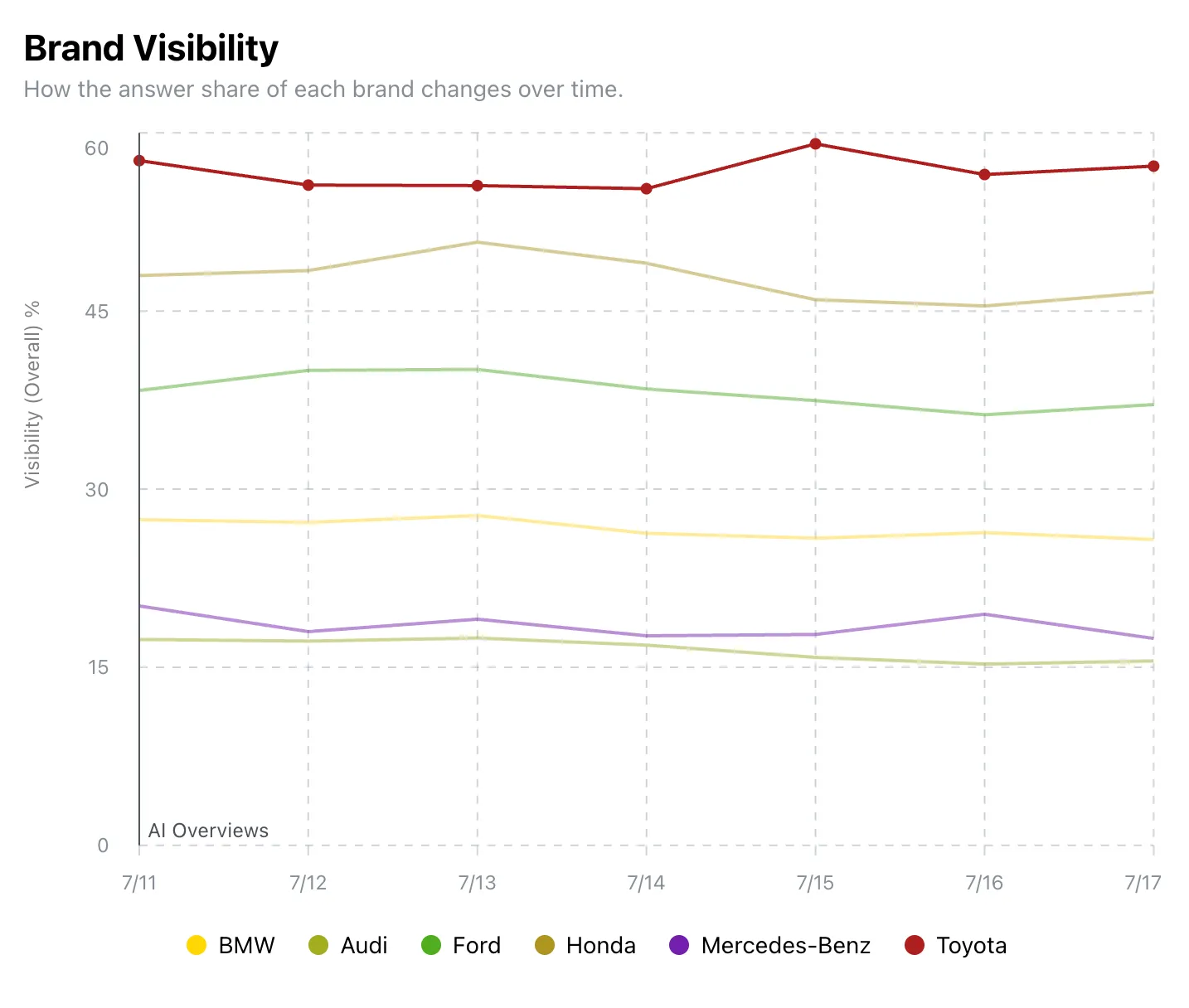
Instead of tracking page views and search rankings, GEO success depends on content mention rates, citation frequency, and feature rates across AI-generated responses. The content pieces that get featured consistently in AI responses drive qualified prospect discovery while others remain buried in search results.
  • Read more

    Your Competitors Are Already Creating AI-Optimized Content (While You're Not)

    Content teams that understand GEO principles are creating material specifically designed for AI platform consumption. This isn't about gaming algorithms - it's about understanding how AI platforms evaluate, cite, and feature authoritative content when prospects research solutions in your category.

    For content creators, this raises a critical question: which specific topics and formats should you prioritize to get your expertise featured when prospects ask AI platforms about solutions like yours?

How Gauge Transforms Your Content Strategy for GEO Success

See Exactly Which Topics Get Your Competitors Featured (But Not You)

Our content gap analysis (systematic comparison of which topics get competitors mentioned in AI responses versus your brand) reveals specific questions where competitor content gets featured while yours doesn't. Combined with our prompt intelligence capabilities, you'll see exactly which prompts drive visibility in your category.

For example, if your competitor gets cited when users ask ChatGPT "Top HR software for remote teams" but your brand never appears, that's a high-impact content gap worth targeting.
  • Read more

    Content Gap Analysis Shows You:

    • Specific questions where competitors get mentioned but you don't
    • Content formats that perform best on each AI platform
    • Topics where your expertise isn't represented in AI responses
    • High-performing prompts in your industry that generate consistent competitor mentions

    Find the Content Sources That AI Platforms Actually Trust and Cite

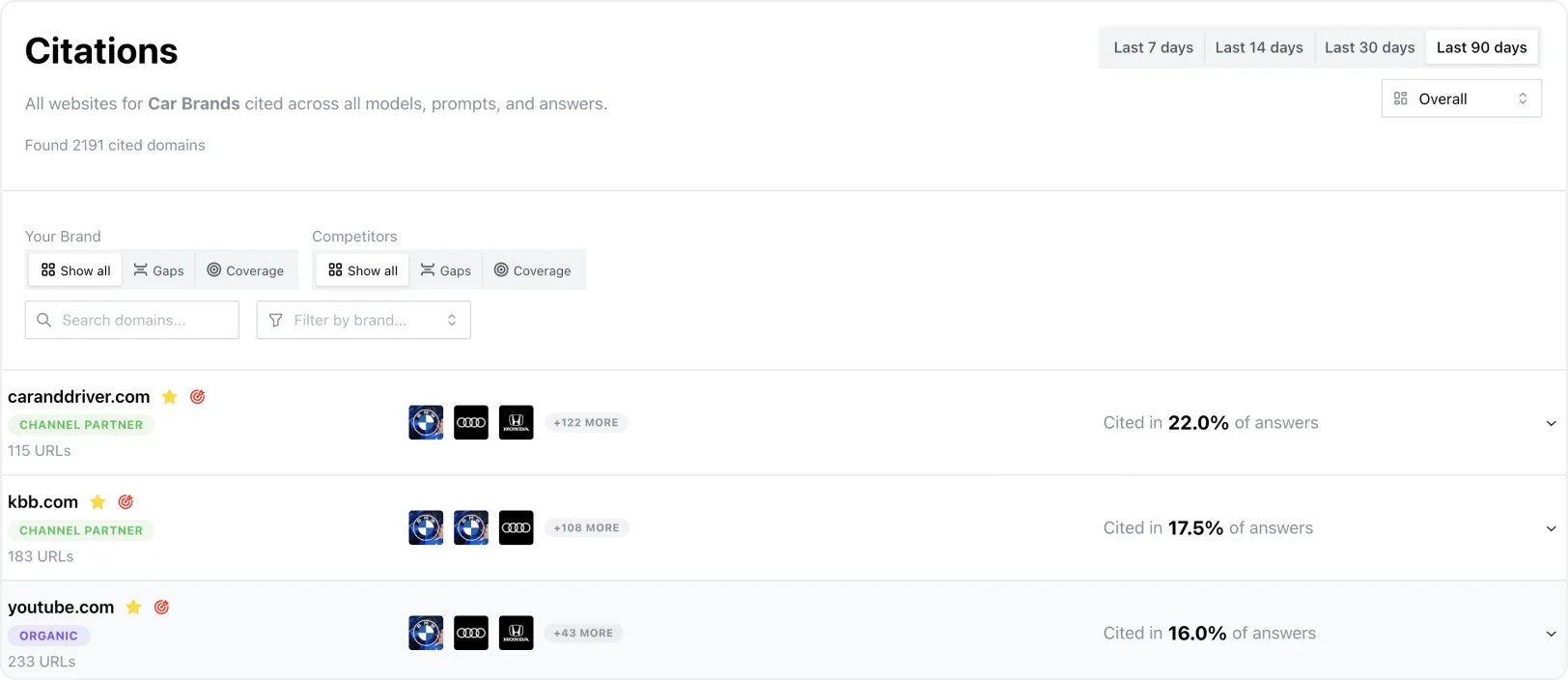
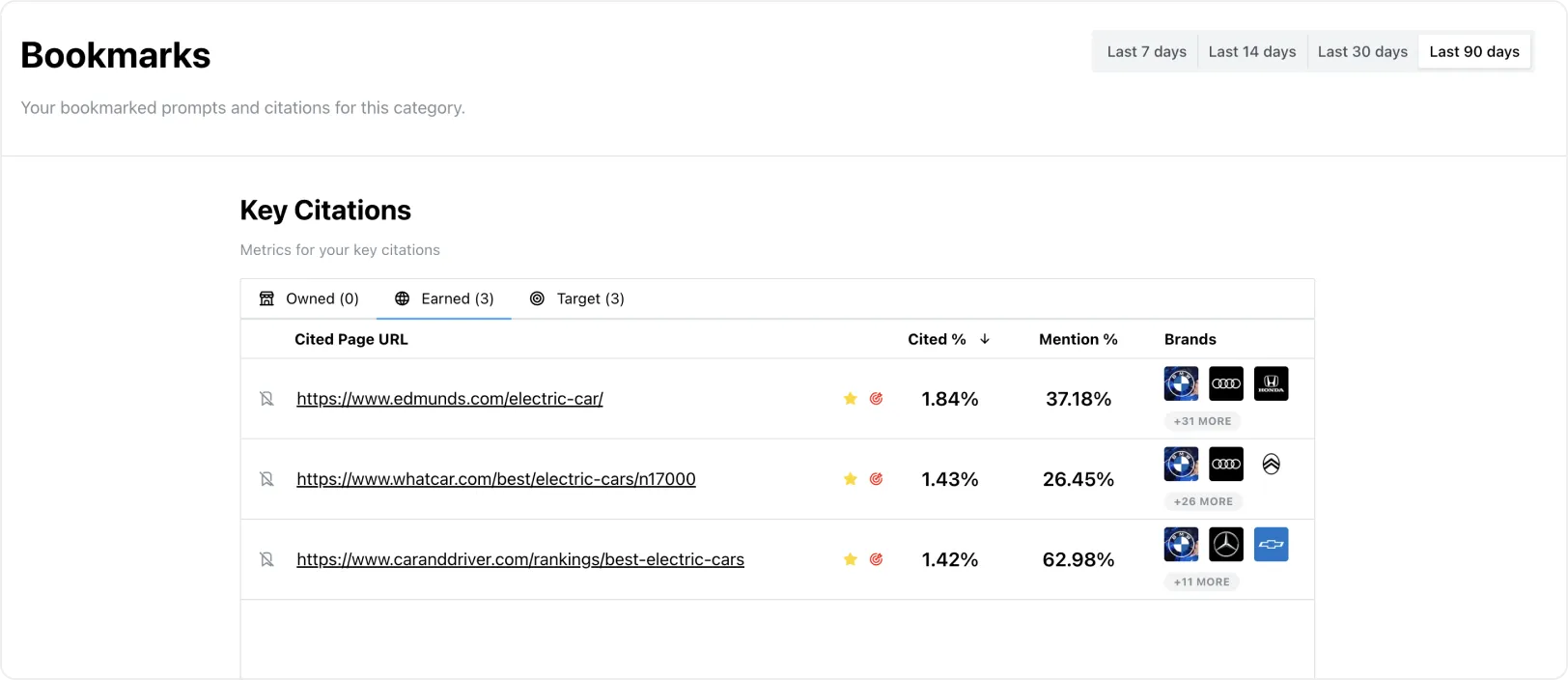
    Our citation intelligence (analysis of which sources each AI platform references when discussing your industry) identifies content types, websites, and formats that get featured consistently.

    For instance, we might discover that Google AI Overviews frequently cites industry reports with data tables, while Gemini prefers comprehensive tutorials with step-by-step instructions. These insights help content teams understand what kind of material gets featured and why.

    Citation Intelligence Reveals:

    • Which publication types each AI platform trusts and references most
    • Optimal content length and structure for platform-specific consumption
    • Third-party sources with highest citation rates in your category
    • Content characteristics that correlate with AI platform mentions

    Get Content Creation Recommendations Through Our Action Center

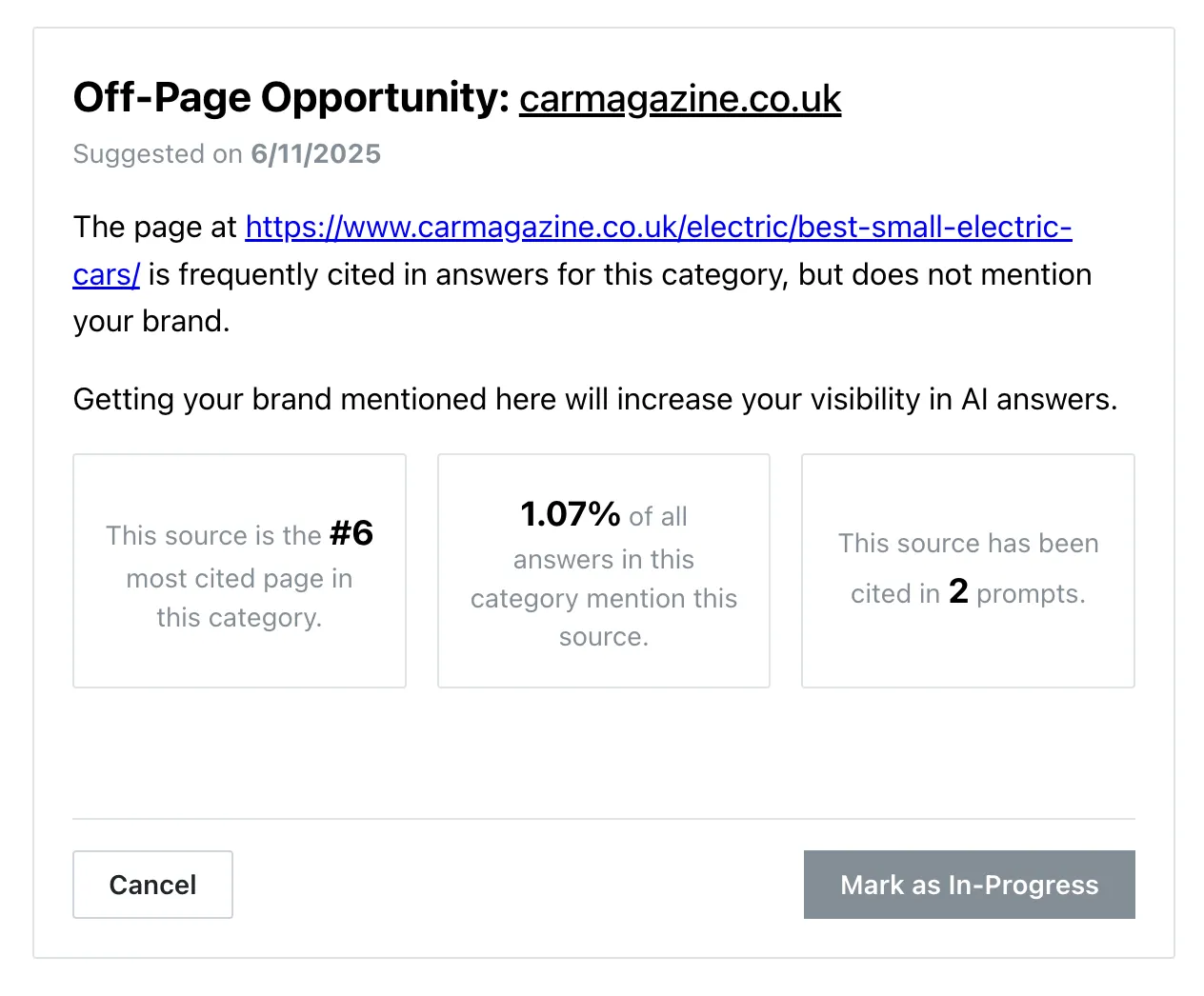
    Our Action Center doesn't just identify content problems - it provides specific, prioritized recommendations for content creation and optimization based on actual AI platform behavior. You'll get actionable content gaps ranked by impact potential and implementation difficulty.

    Action Center Provides:

    • Prioritized content creation opportunities with impact scoring
    • Content format recommendations for maximum AI visibility
    • Topic clusters that drive mentions across multiple platforms
    • Content optimization tactics for existing high-performing pieces
    • Implementation timelines and resource requirements for each recommendation

    See How Content Changes Impact Your GEO Performance

    Track how your content optimizations affect mention rates across AI platforms over time. When you publish GEO-optimized content, you'll see exactly how it performs and which platforms feature it most often.

    Content Teams See Real GEO Results with Gauge

    One customer implemented our content gap recommendations by creating AI-optimized articles targeting the topics we identified. They went from appearing in 22% of relevant AI-generated responses to 42% in just four days after publishing content addressing their biggest gaps.

    Another marketing team focused on the citation opportunities we identified and tripled their content visibility by optimizing existing pieces for AI platform consumption and creating targeted content for high-opportunity topics.

    Content teams using our GEO insights see results in days, not months, because they're creating material AI platforms can actually discover and feature.

    You're probably thinking: if my content is high-quality and comprehensive, why aren't AI platforms discovering and featuring it when prospects research my industry?

Case Studies

Sanctum

Crypto
Sanctum's AI search visibility grew from 16.7% to 47.5% in just six months. They are now the 5th most cited domain in the entire Solana liquid staking space, appearing in 25.6% of all AI answers across major LLMs.
See Full Case Study

"Honestly, I was surprised how fast it happened. The case studies got me excited, but I tried to stay realistic. And then we just started seeing the numbers move"

Author
Head of Marketing
,
Sanctum

Vellum AI

Finance
In just seven months, Vellum's visibility surged from 1.4% to 40.3%. Today, they are cited in 36.6% of all AI answers in their industry across six major LLMs, rank first in first-party citations, and hold the third most cited article in the entire space. Vellum now sits 2nd in overall AI visibility, right behind zapier by 0.2% visibility.
See Full Case Study

"AI search was and still very much is the wild west, so it was important that we partnered with someone who truly understood the space. From our first conversation, Gauge demonstrated that level of expertise and helped me build a clear picture of what we needed to do to win."

Nick
Technical Content Lead
,
Vellum AI

LedgerUp

Finance Automation
In under four weeks, LedgerUp’s visibility skyrocketed from 1% to 17%—a 1,713% increase. Today, they're content is cited in 33% of AI answers with 32.3% visibility across the six major LLMs, more than doubling the reach of platforms like Reddit or YouTube. With a dominant 24% lead over their closest competitor, LedgerUp has moved from invisible to the undisputed leader in AI-driven search.
See Full Case Study

"The 'Ask Gauge' agent made improving our AI SEO so simple. It analyzed our data, found our gaps, and recommended exactly what to write. We barely had to spend time on the platform, which allowed us to consistently put out a piece of content every day"

Mikey
Founding Member
,
LedgerUp

Eco

Crypto
‍In under 4 weeks of using Gauge, Eco increased their visibility in AI answers by over 5x. Eco went on to capture over 37% of all first-party citations, and the #1 spot among their direct competitors.
See Full Case Study

"Since working with Gauge, Eco’s search impressions on Google grew by 200% month-over-month. Bing saw even more success with 300% month-over-month growth. Gauge has also significantly cut down the resources needed to execute a competitive AI and search strategy. At Eco, we are able to do this with one team member, who is also focused on strategy and execution for other marketing channels."

Jay
CMO
,
Eco

Standard Metrics

Finance
In just two weeks of focused implementation, Standard Metrics more than doubled their visibility in AI answers, with an increase from 9.4% of the answer share to 23.8% overall.
See Full Case Study

"Prospects started telling us they were finding us from ChatGPT."

John
CEO
,
Standard Metrics

Our AI Visibility Software Gives You Complete Control Over Your AI Presence

01

Track

Gauge monitors AI-generated answers across platforms to detect mentions of your brand.
02

Analyze

Analyze what content is cited, what’s being left out, and how your brand stacks up against competitors.
03

Action

Gauge gives you clear next actions to improve your presence, backed by real data on your brand and competitors.

Understand Your Brand’s AI Performance

Case Study
Sanctum: From 16.7% to 47.5% AI Visibility in 6 Months
Sanctum powers liquid staking for some of the biggest names in crypto. See how they went from 16.7% to 47.5% AI visibility and became a top 5 cited domain with Gauge.
Announcement
Ask Gauge: The Agentic Marketer
Gauge is your marketing agent for organic, paid, and AI search.
Case Study
How Vellum Dominated AI Search in a Matter of Months
How Vellum went from 1.4% AI visibility to 40.3% visibility in just 7 months

Stop Prompting and Start Measuring

Get the complete toolkit you need to fully own, understand, and improve your brand's presence in AI.

FAQs

Find answers to common questions about our app and services.
  • What is generative engine optimization and how does it help my content strategy?

    Generative engine optimization (GEO) focuses on creating content that gets featured when AI platforms generate responses about your industry. For example, when someone asks ChatGPT "What are the best email marketing tools?", the brands mentioned in that response gain qualified prospects while others remain invisible. Unlike traditional SEO that targets search rankings, GEO helps content teams create material that AI platforms can discover, understand, and cite when prospects research solutions.

  • How is content optimization for GEO different from regular SEO content?

    Traditional SEO content targets search engine algorithms, while GEO content targets AI platform consumption patterns. For instance, Perplexity favors content with clear Q&A structure and supporting links, while ChatGPT prefers comprehensive guides. The goal is getting featured in AI responses rather than ranking high in search results.

  • Which content formats work best for generative engine optimization?

    Each AI platform has preferences: Google AI Overviews frequently cite industry reports with data tables, Gemini prefers step-by-step tutorials, and ChatGPT favors comprehensive content that directly answers specific questions. Effective GEO content includes detailed explanations with clear focus, authoritative information with supporting data, and well-organized structure with logical flow.

  • How do I start implementing GEO for my content?

    Begin with these key steps:

    • First, identify which prompts consistently cite competitors but not your brand
    • Second, analyze your existing content to see where you have expertise gaps
    • Third, create comprehensive content targeting your biggest competitive gaps
    • Fourth, monitor how new content affects your mention rates across platforms
    • Finally, scale successful approaches to additional topics and content types
  • What should I focus on first to improve my content's AI visibility?

    Start with your biggest competitive content gaps where you have clear expertise but aren't getting cited. Look at prompts where competitors appear consistently, identify topics where you can create authoritative content, and focus on 3-5 high-impact opportunities rather than trying to address everything at once.

  • Can I use GEO strategies for my B2B software company?

    Absolutely. GEO is particularly effective for B2B content because business buyers increasingly use AI platforms for initial research and vendor discovery. According to Harvard Business Review research strategic content optimization can significantly alter LLM responses to consumer queries, making brand visibility in AI-generated responses critical for prospect discovery. Gauge helps B2B content teams create material that gets featured when prospects research solutions, making GEO essential for modern B2B content strategy.

  • How can I identify content gaps that impact my GEO performance?

    Content gap analysis involves comparing which topics get competitors mentioned versus your brand. For example, if competitors appear when users ask "Top CRM software for startups" but your brand doesn't, that's a high-impact gap. Gauge analyzes these patterns across all major AI platforms and shows you specific content creation opportunities rather than guessing what topics to address.

  • How quickly can I see results from GEO-optimized content?

     Content teams typically see improvements within days of publishing optimized material. One customer increased their mention rate from 22% to 42% in four days after creating content targeting specific gaps we identified. Success depends on addressing topics where competitors currently dominate AI responses using formats that AI platforms prefer.

  • What should I focus on first for better content GEO performance?

    Start with high-impact content gaps where competitors consistently get featured but you don't. Most successful strategies follow this approach: identify specific questions where competitors dominate, create comprehensive content addressing those topics, optimize existing high-performing content for AI consumption, and track performance across different platforms.

  • How do I optimize existing content for better GEO performance?

    Restructure material to match AI platform preferences. This includes adding comprehensive topic coverage, improving structure with clear headings, including supporting data and examples, and ensuring content provides complete answers. Focus on topics where you have expertise but currently lack AI visibility.

  • Can I use GEO strategies for my B2B software company?

    Absolutely. B2B prospects increasingly use AI platforms for vendor research. According to Salesforce Research, 79% of business buyers expect to interact with AI during vendor evaluation. Gauge helps B2B content teams create material that gets featured when prospects research solutions.

  • How do I measure success with generative engine optimization?

    GEO metrics focus on content performance rather than traditional SEO metrics: mention rate across tracked topics, feature frequency compared to competitors, topic coverage compared to industry leaders, and citation rate across different AI platforms. Gauge provides these metrics in a dashboard designed for content teams.

  • Which AI platforms should I optimize my content for?

    Gauge tracks performance across ChatGPT, Perplexity, Google AI Overviews, and Gemini since these have the largest user bases for business research. Each platform has different content preferences, so comprehensive GEO requires understanding performance across all major platforms rather than focusing on just one.

  • What makes content more likely to be cited by AI platforms?

    AI platforms favor content that provides comprehensive, authoritative information on specific topics. Content that gets featured consistently addresses topics completely, includes supporting data and examples, demonstrates expertise, uses clear structure that's easy to parse, and focuses on providing value rather than promotional messaging.

  • How do I get started with content optimization for generative engines?

    Book a demo to see how our platform works and learn about generative engine optimization strategies for content teams. We'll demonstrate our content gap analysis capabilities and show you the methodology content teams use to create AI-optimized material. This gives you a clear understanding of how to transform your content strategy for maximum AI platform visibility.